
Fronius inverters
Fronius inverters are Austrian-built three-phase string inverters that convert the direct current from a photovoltaic array into alternating current for the building and the grid. Three families are stocked: Fronius Symo for three-phase grid-tie systems from 3 to 20 kW, Fronius Eco for larger commercial arrays from 25 to 27 kW, and Fronius Symo GEN24, the hybrid line with battery readiness and integrated backup power. All of them use active cooling with a field-replaceable fan and integrated data communication into Solar.web. Browse the wider inverter range or the full Fronius offer. Guide
Three-phase inverters
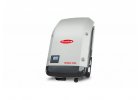
Fronius Symo is a line of grid-tie inverters with a high degree of output variability, ranging from 3 to 20 kW. This wide range of models makes them one of the most commonly used inverters in both residential and commercial sectors.
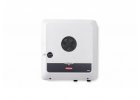
Fronius Symo GEN24 is a hybrid inverter series with high output and efficiency, designed to be used in smaller commercial and domestic solar systems. This 3-phase inverter allows for battery connection energy backup and is equipped with the latest technologies, making it one of the best choices for homes or small businesses.
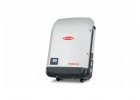
Fronius Eco series of inverters is designed for higher output levels ranging from 25 to 27 kW, making them more suitable for larger commercial installations. However, they are not recommended for use in domestic power plants.
Product sorting
List of products


Related Fronius categories
- Fronius Symo
- Fronius Eco
- Fronius Symo GEN24
- All Fronius inverters
- Smart meters
- Batteries for photovoltaics
Fronius inverters: three families, one system philosophy
Fronius builds three-phase string inverters around a shared platform: active cooling instead of passive convection, a field-replaceable fan, an integrated data communication package with Ethernet, WLAN and Modbus, and free monitoring through Fronius Solar.web. The differences between the families are the application and the topology, not the underlying engineering approach.
Fronius Symo is the classic On-Grid line from 3 to 20 kW, used on family houses and small commercial roofs. Fronius Eco covers 25 to 27 kW and is aimed squarely at large commercial arrays, not at domestic installations. Fronius Symo GEN24 is the hybrid generation: it is battery ready on the DC side and offers integrated backup power, either as the single-socket PV Point or as Full Backup for the whole installation.
FROM THE FIELD
"The mistake I see most often on Fronius jobs is treating the Smart Meter as an optional accessory. Without it the inverter has no idea what the house is consuming, so dynamic export limiting, consumption graphs in Solar.web and battery charge control on a GEN24 simply will not work. Plan the meter position in the distribution board at the design stage, not on commissioning day."
Ladislav Proc · Photovoltaics specialist, ONSA Plus
How to choose a Fronius inverter
Start from the question of whether the system will ever store energy. That single decision splits the range: a pure grid-tie array points at Symo or Eco, while anything that will hold a battery or keep sockets alive during an outage points at Symo GEN24.
After that, work through array size and how the strings are laid out, then MPP tracker count against the number of roof orientations, then the metering and communication you need for export limiting, and finally the practical matters: where the unit hangs, how it is cooled and how the warranty is registered.
Show the full guide Close the guide
Which family: Symo, Eco or Symo GEN24
All three are three-phase, so the choice is about application rather than about grid connection type.
- Fronius Symo: grid-tie output from 3 to 20 kW. The wide model ladder is why it turns up on both residential and commercial roofs. No battery on the DC side and no backup function.
- Fronius Eco: 25 to 27 kW for larger commercial installations. It is designed for big arrays of consistent orientation and is not the right unit for a family house.
- Fronius Symo GEN24: the hybrid three-phase generation for domestic and smaller commercial systems. Battery readiness on the DC side plus integrated backup power, so it is the one to specify whenever storage is on the table now or later.
Mounting: SnapINverter and the GEN24 wall bracket
Fronius separates the wiring from the electronics. With the SnapINverter concept used on Symo and Eco, a wall bracket holding the connection area is fixed and wired first, and the power stage is then hooked on and snapped into place, so one person can hang the unit and the electrician can pre-wire before the expensive part ever reaches site. Servicing means releasing the power stage and leaving the cabling untouched.
The GEN24 generation keeps the same idea in a redesigned form: the mounting bracket carries the connection area with the DC, AC, battery and backup terminals, and the inverter body attaches to it. In both cases the bracket must sit on a surface that can carry the unit, with the clearances around it that the manual specifies for airflow.
MPP trackers, Superflex and string design
Most Symo and Symo GEN24 models offer two independent MPP trackers, which is what Fronius markets as Superflex Design: the two inputs do not have to carry equal string lengths or equal power, so you can put a long string on an east roof and a shorter one on a west roof and each still runs at its own optimum. That freedom is what makes complicated roofs workable without module-level electronics.
- Two trackers let you serve two orientations, two tilts or two shading regimes independently.
- Asymmetric loading means the trackers can be sized differently, so you are not forced into a symmetrical roof layout.
- Voltage window still rules. Check string open-circuit voltage at the lowest expected temperature against the maximum DC input voltage before you finalise the layout.
- Large uniform arrays on an Eco do not need tracker flexibility, they need string inputs and a clean, repeatable DC layout.
Tip from practice
Order the Fronius Smart Meter with the inverter, not afterwards. It is the component that measures the house at the grid connection point and it is required for dynamic export limiting, for consumption data in Solar.web and for battery charge and discharge control on a GEN24. Check whether the installation needs the three-phase or the single-phase version before ordering.
Active cooling and the replaceable fan
Fronius uses active cooling: a fan moves air through the heatsink so the power stage stays inside its temperature window and the inverter holds full output on hot days instead of derating early. The trade-off is a moving part, and Fronius answers that by making the fan field-replaceable, so a worn fan is a service item rather than a reason to swap the inverter.
Siting follows from this. Keep the unit out of direct sun, respect the stated clearances above and below the housing, and avoid dusty enclosed cupboards where the airflow path clogs. Outdoor mounting is possible within the ingress rating stated in the manual for the specific model, but a shaded, ventilated position always ages the electronics more slowly.
Data communication, Solar.web and metering
Data communication is built in rather than bolted on. Symo and GEN24 units include integrated datalogging with Ethernet and WLAN, Modbus TCP and RTU interfaces for building or energy management systems, and a connection to Fronius Solar.web, the manufacturer portal that shows production, consumption and system status and holds the historical record used for fault diagnosis and warranty claims.
Production data comes from the inverter itself. Consumption data, and therefore self-consumption figures and export limiting, needs a Fronius Smart Meter installed at the grid connection point. Zero feed-in and reduced feed-in requirements imposed by a distribution network operator are handled through that meter, and on a GEN24 it is also what tells the battery when to charge and when to discharge. The same measured data is what a Fronius Wallbox uses to charge an electric car from surplus production rather than from the grid.
Backup power and batteries on GEN24
The GEN24 line offers two levels of backup, and they are not the same product decision.
- PV Point: a single dedicated emergency socket that is powered from the PV array during a grid outage. It needs no battery, but it only works while there is enough sunlight and it supplies that one outlet, not the house.
- Full Backup: the installation, or a defined backup section of it, is disconnected from the grid and supplied by the inverter and the battery. It requires a battery, the correct switching and earthing arrangement in the distribution board, and an installer who has set the unit up for that mode.
- Battery readiness: GEN24 units are prepared for DC-coupled storage from the compatibility list Fronius publishes for the model. Confirm the battery against that list before ordering, because approval, not just voltage class, decides what may be connected.
- Retrofit: a GEN24 installed without storage can take a battery later. The practical work is the battery cabling, the switching for backup and reconfiguration, so leave conduit and board space at first fit.
Fronius family comparison
| Family | Typical application | Key characteristics |
|---|---|---|
| Fronius Symo | Family houses and small commercial roofs, 3 to 20 kW | Three-phase grid-tie, SnapINverter mounting, Superflex Design, integrated datalogging |
| Fronius Eco | Larger commercial arrays, 25 to 27 kW | Three-phase grid-tie for big uniform arrays, SnapINverter mounting, not intended for domestic use |
| Fronius Symo GEN24 | Homes and smaller commercial systems with storage or backup | Hybrid three-phase, DC battery ready, PV Point or Full Backup, GEN24 wall bracket |
| Fronius Smart Meter | Any system needing export limiting or consumption data | Measures at the grid connection point, enables Solar.web consumption view and battery control |
| Shared platform | All three inverter families | Active cooling with replaceable fan, Ethernet, WLAN, Modbus, Solar.web, warranty registration |
Swipe the table to the left
Frequently asked questions about Fronius inverters
What is the difference between Fronius Symo and Symo GEN24?
Symo is a pure three-phase grid-tie inverter from 3 to 20 kW with no battery input and no backup function. Symo GEN24 is the hybrid generation: it is prepared for a DC-coupled battery and offers integrated backup power through PV Point or Full Backup.
When should I choose Fronius Eco instead of Symo?
Choose Eco for larger commercial installations in the 25 to 27 kW range, where the array is big and consistently oriented. Fronius does not position the Eco line for domestic power plants, so a family house is normally a Symo or a Symo GEN24 job.
Do I need a Fronius Smart Meter?
Yes, for anything beyond plain production monitoring. The Smart Meter measures at the grid connection point and is required for dynamic export limiting, for consumption and self-consumption data in Solar.web, and for controlling battery charging and discharging on a GEN24.
What is the difference between PV Point and Full Backup?
PV Point powers one dedicated emergency socket directly from the PV array during an outage, with no battery needed, so it works only while the sun is shining. Full Backup supplies the whole installation or a defined backup section and requires a battery plus the correct switching in the distribution board.
Can I add a battery to a Symo GEN24 later?
Yes. GEN24 units are battery ready on the DC side, so storage can be retrofitted without replacing the inverter. Check the battery against the compatibility list Fronius publishes for the model, and leave cable routes and space in the board at first fit to keep the retrofit simple.
Can I connect a battery to an existing Fronius Symo?
Not on the DC side. Symo is a grid-tie inverter without a battery input, so storage has to be added AC coupled with a separate battery inverter, or the Symo has to be replaced by a Symo GEN24. Compare options in batteries for photovoltaics.
Can one Fronius inverter handle two roof orientations?
Yes, on models with two MPP trackers. Fronius calls this Superflex Design: the two inputs can carry unequal string lengths and unequal power, so an east string and a west string each track their own optimum instead of dragging one another down.
What does SnapINverter mounting mean in practice?
The wall bracket containing the connection area is fixed and wired first, then the power stage is hooked on and snapped into place. The electrician can pre-wire before the inverter arrives on site, and servicing means removing the power stage while all cabling stays connected to the bracket.
Is the cooling fan a weak point?
Active cooling is what lets the inverter hold full output on hot days instead of derating early, and Fronius designs the fan as a field-replaceable service part. Mount the unit out of direct sun with the specified clearances and out of dusty enclosed spaces to keep the airflow path clear.
Do I have to register the inverter for the warranty?
Yes. Fronius requires the inverter to be registered with its serial number after commissioning to activate the extended warranty terms, and the registration deadline runs from installation. Keep the commissioning record and the Solar.web system data, because both support any later claim.
Battery compatibility, backup options and grid code settings follow the manufacturer's current documentation for the specific model and firmware version.
About ONSA Plus
Why installers across Europe source Fronius from us
ONSA Plus is a European B2B distributor of photovoltaics, battery storage, heat pumps and EV charging stations. In our own EU warehouses we keep over 1,500 products from 25+ brands, including Huawei, Solis, SolaX and Dyness.
We are not just a trading company. We design and service energy systems ourselves, so we answer questions on Fronius string design, metering and backup options from engineering practice, not from a catalogue. You handle a warranty claim directly with us and you buy per job.


